 TileWhirl
Classroom and homeschool
TileWhirl trays turn math into something you can hold. Every pattern is free to print, so a class can share trays and still each have a pattern.
Group murals for the square tray
Each student builds one 12 × 12 plate on their own square tray. When the trays are pushed together, the plates join into one big picture: a T. rex, the Statue of Liberty, a nine-block quilt. Every plate fits in one standard box, so nobody has to share tiles.


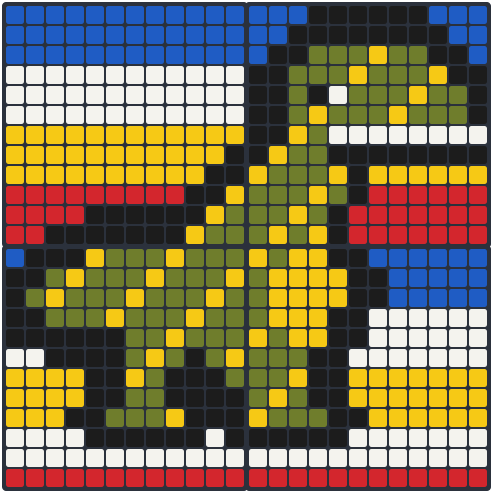
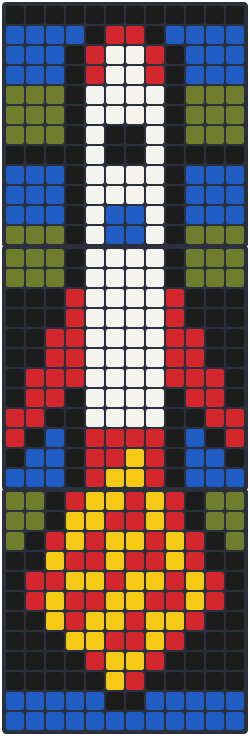
32 murals for groups of 3, 4, 6 or 9 builders (6 for 3, 13 for 4, 10 for 6, 3 for 9). Each one has a printable sheet per student with that plate's tile counts and a map showing where it goes.
What group murals teach
| Topic | Try this |
|---|---|
| Coordinates and scale | Plates are labeled like a grid: A1, A2, then B1. Inside each plate, rows A to L and columns 1 to 12. Ask where tile D7 of plate B2 sits in the whole mural. |
| Area and multiplication | A 3 × 2 mural has 6 plates of 144 tiles. How many tiles in all? Check against the number on the page. |
| Quilt geometry | In the quilt murals each plate is a complete quilt block. Find the lines of symmetry in one block, then in the whole quilt. |
| Fractals | The Fractal Tree repeats the same branching shape at smaller sizes. Where does the pattern stop, and why? |
| Estimation and data | Before building, estimate how many tiles of each color your plate needs. Then compare the counts across all the plates. |
| Teamwork | Plates have to line up exactly at the edges. Neighbors check each other's seams before the reveal. |
What the trays teach
| Topic | Try this |
|---|---|
| Counting and data | Each pattern lists its tile counts. Ask students to predict the counts before they build, then check. |
| Coordinates | Square patterns use rows A to L and columns 1 to 12. Call out positions like "red at D7" and build a picture together. |
| Fractions and percentages | What fraction of the Heart pattern is red? Of the whole tray? Compare two patterns. |
| Symmetry | Mirror Match and Spin challenges on the triangle, star and hex trays. Why does the star need every color count to be a multiple of five? |
| Odd and even | The star tray can't be colored with two alternating colors, because five is odd. Students can discover this themselves. |
| Shapes and tiling | Four hex tiles make a bigger copy of the same shape, and nine make an even bigger one. The hex tray's layouts show it. |
| Logic and proof | The hex Spiral Problem: possible on paper, impossible from the box. Why? |
Ideas for the class
- Pair students: one reads coordinates aloud, the other builds.
- Memory Flash: 30 seconds to study a pattern, then rebuild it. Score the number of correct tiles.
- Design a new pattern on graph paper, then count the tiles needed and check it fits the box.
Interested in class sets? Email hello@tilewhirl.com.